 Synapsed
Make governance part
of how AI is built.
The Synapsed AI Governance Framework connects the decisions an organisation needs to make with the work required to carry them out. Responsibilities, lifecycle activities, controls and evidence form one operating model.

Make each decision actionable and reviewable.
Responsibilities
Identify who makes a decision, implements the work and reviews the outcome. Connect product, governance, engineering and assurance roles.
Ask: who owns the decision and who needs to be involved?
Lifecycle activities
Place governance activities where they can influence the AI system, from defining its purpose through maintaining it in operation.
Ask: what needs to happen before the next step?
Controls
Translate the intended boundaries and relevant requirements into technical and operational measures.
Ask: how is the expectation implemented in this system?
Evidence
Identify the records, test results and observations needed to review implementation and support the next decision.
Ask: what supports the conclusion, and what remains unresolved?
Connect governance to delivery and change.
| Stage | Questions to resolve | Examples of evidence |
|---|---|---|
| Define | What is the intended use? Who is responsible? Which impacts and requirements need attention? | Agreed scope, ownership, initial assessments and requirement decisions. |
| Design | How will the system meet its requirements and stay within its boundaries? | Design decisions, threat models and planned controls. |
| Develop | How are the chosen controls implemented and reviewed? | Implementation records, reviews and test evidence. |
| Deploy | What supports the release decision? Which limitations or issues remain? | Validation results, accepted issues, approvals and operating instructions. |
| Maintain | What has changed, and what needs to be reassessed? | Monitoring, incidents, repeated tests and reviewed change decisions. |
Follow an access boundary through a RAG application.
An internal knowledge assistant should only use information the requesting user is authorised to access. Governance connects that expectation to delivery and review.
Assign ownership
The product and data owners define the access boundary, the information classes and who can approve a change.
Implement and test
The engineering team applies controls across retrieval and response generation. Tests examine whether users can obtain information outside their permissions.
Review and revisit
The team records test conditions, observations and unresolved issues. Changes to sources, permissions or components trigger a review of the relevant evidence.
Connect the method with its evidence.
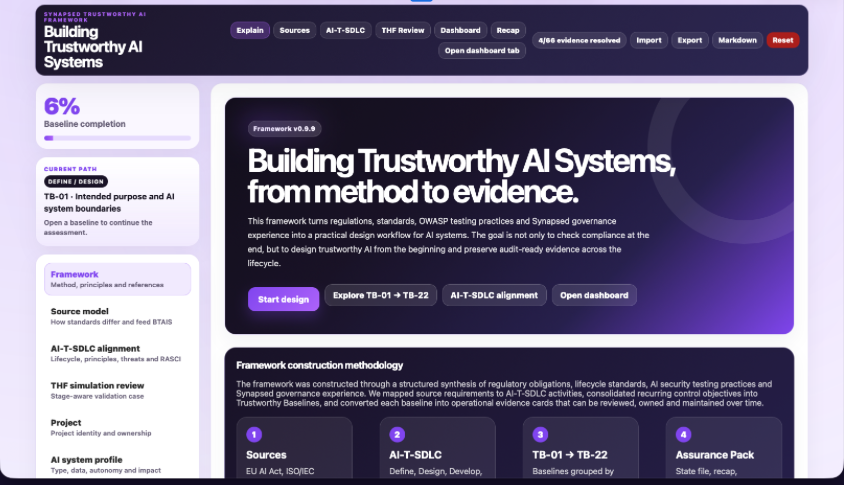
The research application provides a concrete view of the relationship between the framework, lifecycle activities and evidence. The screenshot below shows an example working state.
Bring governance into your AI initiative.
Start from the organisation’s priorities and the AI systems it is building. We help adapt the framework to the decisions, practices and evidence your teams need.